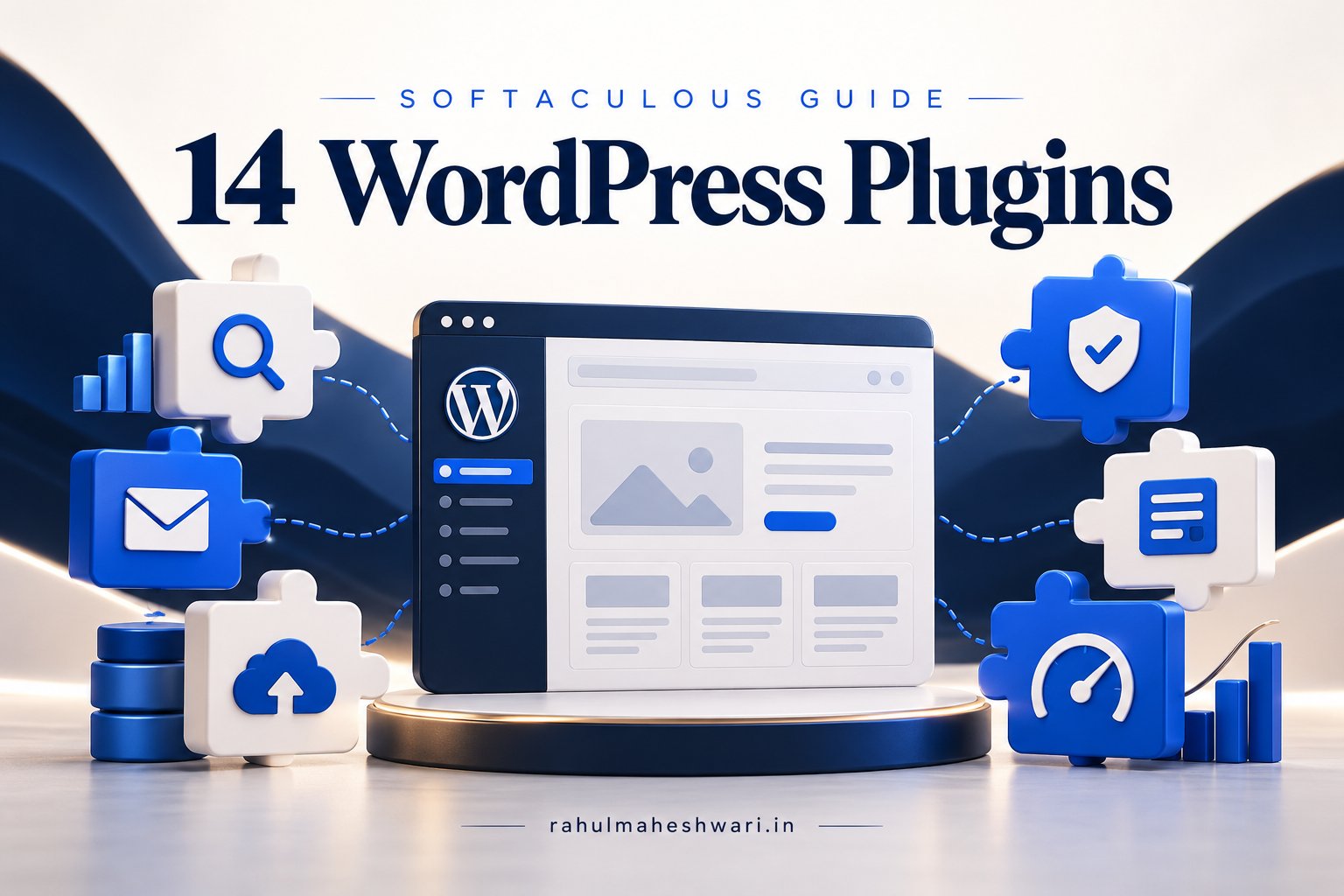
Softaculous featured plugins can help a business add forms, backups, email delivery, SEO settings and other functions to WordPress. The difficult part is choosing which ones solve a real problem without duplicating tools already working on the website.
This guide explains the 14 plugins shown in the Softaculous featured selection and a practical way to evaluate them. It is based on vendor documentation and plugin listings checked on 23 October 2026, rather than a hands-on benchmark or security audit. Features, licensing and host availability can change.
What are Softaculous featured plugins?
Softaculous is commonly available through hosting control panels. Its WordPress management tools can offer optional plugins alongside installation management. SoftWP is a related WordPress assistant with onboarding and AI features. Seeing a plugin in the featured list does not mean it is installed, needed or included in your hosting package.
The SoftWP installation documentation describes bundled Pro access for eligible licenses. Check your own account and the provider’s terms before making a purchasing decision. A visible Install button is not proof that every premium feature is licensed.
Useful when the team wants its task board inside WordPress.
Start with business outcomes, then choose tools
For a service business: enquiries and reliable follow-up
Connect form submissions with reliable email delivery and a clear follow-up process.
A contact form has value only when someone receives and acts on its submissions. Evaluate FormLayer if you need a new form builder. If WPForms, Contact Form 7 or another form system already handles your requirements, there may be no reason to migrate.
GoSMTP addresses a different part of the process: transporting WordPress email through a configured SMTP or email service. Submit a test enquiry with a unique subject, confirm receipt, check the reply address and verify that the lead reaches the intended person. Provider limits and domain authentication still matter; installing an SMTP plugin does not guarantee inbox placement.
For an online store: recovery and transaction reliability
Evaluate store performance alongside recovery and transaction reliability.
Backuply belongs in a recovery plan. Decide how much new order data you could afford to lose, then choose a backup frequency and retention policy that match that tolerance. A backup stored only inside the hosting account can be lost with that account. Keep a separate copy and prove that it restores on staging.
SpeedyCache is worth evaluating when page delivery or assets need optimization. Test product pages, filters, cart, checkout and account screens after configuration. Do not judge success only by a speed score: a fast page with a broken purchase button is a failed change. Coordinate with your hosting provider’s cache and avoid letting multiple tools manage the same page-cache layer without a clear plan.
For a content website: discoverability and distribution
SiteSEO manages SEO-related settings, but installing it beside an existing SEO plugin is not an automatic improvement. Before switching, record your titles, descriptions, canonical URLs and sitemap settings. Test the rendered output after migration.
ShareMyPost adds sharing controls for readers. SocialFeeds brings social content into the website. These solve opposite directions of distribution: sharing a page outward versus bringing a feed inward. Decide whether either action supports the page’s goal. A purchase or enquiry page may benefit more from a clear call to action than an additional social feed.
Where the other tools fit
Pagelayer is a visual builder, so assess it as a design-system decision. An established Elementor or WPBakery site should not gain a second builder merely because it is offered in a bundle. Existing layouts will still depend on the builder that created them.
CookieAdmin provides a consent interface. Map your actual analytics, advertising tags and embeds, then test acceptance, rejection and changed preferences. A banner’s appearance alone does not establish that tracking respects the visitor’s choices.
Deskuss can organize customer support, while Kanbanz can organize the team’s work. Start with a small pilot: one support queue or one editorial board. Define who owns each item and what counts as completed work before adding complexity.
FileOrganizer gives file-management capabilities inside WordPress. If cPanel or SFTP already covers the need, another file manager may be unnecessary. Keep permissions narrow and remove unused tools. Loginizer supports login protection, but updates, appropriate user roles and incident response remain separate responsibilities.
A practical selection process
Write down the missing capability and how you will measure success.
Inventory existing plugins, hosting features and third-party services.
Check the official listing, edition requirements and compatibility information.
Take a recoverable backup and trial one change on staging.
Test the relevant business journey on mobile and desktop.
Record the configuration, owner and renewal conditions; remove redundant tools after validation.
Frequently asked questions
Should I install every featured plugin?
No. A small set that covers the website’s real needs is easier to maintain than a catalogue installed without a purpose.
Will SiteSEO improve rankings automatically?
It can help manage technical settings and page metadata. Rankings still depend on the website, content, competition and how search engines evaluate the pages.
Are these malware-removal tools?
This catalogue covers several functions. Do not treat a backup or login plugin as evidence that an infected site has been fully investigated or cleaned.
Meta Creator Marketing Hub: How Small Brands Can Plan Better Partnerships
Finding a creator is only the beginning. A useful partnership needs the right audience, a clear brief and an organized plan for content, approvals and measurement.
By Rahul Maheshwari · 22 October 2026 · 5 min read
Why creator partnerships need an operating plan
For a small brand, a creator partnership can offer a useful way to explain a product through a relevant voice. It can also create confusion when the audience, deliverables and paid-use expectations are agreed too late. A discovery tool helps with finding people; it does not replace the project brief.
Marketing Dive reported in September 2026 that Meta launched its Creator Marketing Hub with discovery, messaging and ad-readiness features, with updates rolling out through the rest of the year. The report describes expanded Facebook and Instagram creator discovery capabilities. Availability should be checked in the actual business account.
This guide uses that development as a starting point for an independent planning framework. It is not a promise that a particular creator, feature or campaign will produce a fixed return.
Choose audience fit before follower count
Begin with the customer question the partnership should answer. A creator who regularly explains garment fit may suit a clothing comparison. Someone known for general entertainment may have a larger audience without the same connection to the buying decision.
Review several pieces of content, not one successful post. Look at subject consistency, presentation, audience questions and whether the creator can discuss the product naturally. Document what makes the fit plausible rather than relying on a broad label such as lifestyle.
Which audience need does the creator already serve?
How would the product appear in their normal content?
Are the examples and claims compatible with the brand?
Does the creator have the time and production approach the project needs?
What evidence can both sides reasonably review?
A useful shortlist connects the creator’s subject matter with the audience and offer.
Write a brief that leaves room for the creator
A clear brief describes the objective without scripting away the creator’s voice. Include the audience, product information, necessary factual points, prohibited or unsupported claims, deliverables and review process. Explain where the content will lead the viewer next.
Separate factual requirements from creative preferences. Product accuracy may be non-negotiable; the way the creator demonstrates a use case may benefit from their judgment. A brief that treats every preference as a requirement can become difficult to execute.
Brief essentials
Objective · Audience · Offer · Accurate product facts · Deliverables · Review rounds · Timing · Usage scope · Measurement. Keep the current approved version accessible to everyone involved.
Ask the creator to confirm the concept before production. A short outline or rough storyboard can reveal a mismatch earlier than a finished edit.
Discuss usage before the content is finished
Organic posting and paid advertising are different uses of creative work. Agree what the brand expects to do with the content, which accounts and placements are involved, the intended period and who handles the platform permissions. Record responsibilities clearly with the appropriate agreement and specialist input where needed.
Do not assume a platform approval covers every possible reuse. A content file, a creator’s account permissions and a commercial agreement serve different purposes. Check music, third-party footage and other assets for the uses you actually plan.
This is a project-management checklist, not a substitute for advice on a specific contract. The practical objective is to identify the decision early enough that both sides can price and approve the work accurately.
Keep approvals, dates and usage responsibilities organized throughout the partnership.
Use a simple delivery workflow
Shortlist: document audience fit and the proposed creative role.
Scope: agree deliverables, timing, approvals and intended use.
Concept: confirm the idea before filming or design work begins.
Review: check facts, product presentation and the agreed requirements.
Activate: verify the destination, permissions and campaign setup.
Learn: review useful outcomes and decide what should change next time.
Keep a record of the approved asset version and any later edits. If several people can request changes, name one person to consolidate feedback. Contradictory comments can slow the project and weaken the creative.
Define what a useful result looks like
Match the evaluation to the objective. An educational collaboration may help customers understand a product difference. A campaign focused on inquiries needs a way to judge relevance, not only response volume. A store promotion should connect the campaign discussion to the business’s available order data.
Distinguish the creative fee, production work, media spend and any other agreed costs. Otherwise, comparisons between partnerships can hide important differences. Record paid support when reviewing an organic post’s performance.
Use the first collaboration to learn how well the operating process works as well as how the audience responds. A repeatable partnership needs reliable approvals and accurate information, not just an attractive first post.
Frequently asked questions
Should a small brand always choose a smaller creator?
No. Size is only one consideration. Audience fit, creative approach, scope and the available budget should guide the shortlist.
Does a platform hub replace a written brief?
No. Discovery and workflow tools can help coordinate a partnership, but the objective and responsibilities still need to be agreed.
Can I turn every creator post into an ad?
Only consider the intended use after checking the necessary rights, account permissions, asset suitability and agreement with the creator.
Need a clear campaign and content plan?
Let’s turn the next step into a clear, practical plan for your business.
Turn Social Videos Into YouTube Ads: A Practical Creative Testing Guide
You may already have a useful starting point for your next video campaign. Here’s how to adapt it thoughtfully, without treating repurposing as a copy-and-paste task.
By Rahul Maheshwari · 22 October 2026 · 5 min read
Start with the material you already have
Creating a video campaign does not always require a completely new production. A product demonstration, customer-approved explanation or useful social video can provide the foundation for an ad. The challenge is deciding what to keep, what to adapt and what the viewer needs to understand.
Google’s 1 October 2026 Ads Decoded post encourages advertisers to begin with existing creative, follow asset requirements, review available creation tools and use data to guide testing. It also highlights quality and gradual changes rather than simply producing more assets.
Repurpose the idea, review the execution
A good social video can be a starting point. It still needs the right framing, permissions, message and destination for the advertising campaign you plan to run.
Audit the video before you edit
Choose a small set of candidates. For each one, write the audience, the problem it addresses, the product or service shown and the next step. If those points are difficult to identify, editing the format may not fix the underlying message.
Does the video explain something relevant to the campaign audience?
Is the product or offer understandable without reading the original caption?
Are claims accurate and still current?
Do you have permission to use the footage, people, music and other assets in paid advertising?
Does the destination page continue the same message?
Avoid choosing solely by past view count. An entertaining post can be popular without helping someone understand your offer. Judge the candidate against the job the ad needs to do.
Create a focused adaptation brief
A short brief can prevent a long revision cycle. Specify the target audience, one main message, the evidence you can honestly show and the action the viewer should take. Then mark which parts of the original footage support that message.
Make the opening specific
Introduce the relevant problem, product or result clearly. Avoid a lengthy introduction that assumes the viewer already knows your business. The opening should help the right person recognize why the video matters.
Make the middle useful
Show a demonstration, explain a difference or resolve a common objection. Keep supporting information accurate. A conceptual illustration should not be presented as proof of a real customer outcome.
Make the next step consistent
The action in the video and the destination page should fit together. A service explanation should lead to the relevant service or inquiry journey. A product demonstration should not send viewers to an unrelated category.
A clear storyboard gives each edit a purpose before production begins.
Check the format in the actual campaign workflow
Use the platform’s current asset requirements when preparing exports. Review cropping, legibility, sound, captions and important visual elements in the placements you intend to use. Do not assume a file that looked correct in one social feed will work equally well everywhere.
Google’s October post also mentions Asset Studio’s multimodal video creation. Treat any available AI creation tool as part of the production workflow: preview the output, check product accuracy, review claims and confirm brand suitability before approving it.
Use a simple asset register. Include the file version, source footage, usage permission, intended campaign and approval date. That makes later edits and renewals easier to manage.
Build a small test you can learn from
Choose one meaningful question. You might compare an opening based on a customer problem with an opening based on a product demonstration. Keep other important elements similar enough to understand the result.
Before launch, agree the primary outcome and how you will judge quality. A lead campaign should consider useful inquiries, not only video attention. An e-commerce campaign should consider the relevant business records and measurement limits.
Record major changes and allow for the time your customer journey requires. If the landing page changes halfway through the test, document that context. A tidy test log is often more valuable than a dashboard containing many unlabeled variations.
A practical test sheet
Hypothesis · Audience · Message · Asset version · Destination · Primary outcome · Review window · Decision. Fill in each field before adding another creative variation.
Compare a clear hypothesis instead of generating variations without a decision plan.
Respond to creative fatigue with evidence
A decline in performance can have several explanations. Review delivery, audience, offer, website experience and measurement alongside the creative. Do not assume that every dip means a new video is needed.
If a new asset is justified, change something purposeful: a different use case, a clearer demonstration or a better answer to an objection. Recoloring the same message repeatedly may create more files without improving the customer’s understanding.
Frequently asked questions
Can I reuse an organic video as an ad?
It can be a candidate if it meets current requirements and you have the necessary paid-use permissions. Review the message and destination as well as the file format.
How many versions should I create?
There is no universal number. Start with a manageable set that answers a defined test question and fits your production and review capacity.
Can AI create the final version for me?
Creation tools can help, but the finished asset still needs human review for accuracy, permissions, brand fit and campaign suitability.
Want to connect creative with a campaign plan?
Let’s turn the next step into a clear, practical plan for your business.
Google Ads’ New Budget Controls: A Practical Guide for Small Businesses
More control over where your budget goes—provided you understand what the settings actually do. A practical guide to Google’s October 2026 update.
By Rahul Maheshwari · 22 October 2026 · 5 min read
What changed—and why it matters
Small businesses often face an uncomfortable choice: keep a channel active with limited confidence about its role, or turn it off completely. Google’s 14 October 2026 announcement introduces channel prioritization and budget allocation as more flexible controls. The rollout covers several campaign types, but availability and the supported settings vary.
This article explains the announcement and proposes a review process. It is not a recommendation to change every campaign immediately. Start with your account’s available controls and the business outcome you want to protect.
Two separate decisions
Priority helps express which channel group should be funded first. Allocation can set a desired spending boundary for an eligible low-priority channel. Neither replaces a good offer, reliable conversion measurement or a useful landing page.
Understand the controls before using them
Google’s current help documentation describes High and Low priority levels. Budget allocation is based on a percentage of the average daily budget, not actual spend, and works on a best-effort basis. It is not a guaranteed daily spending ceiling.
Important limits: Demand Gen supports prioritization but not budget allocation. In Performance Max and Demand Gen, Google surfaces are grouped as Google channels; this is not a separate slider for every individual surface. Priority may have little effect for target-based bidding when a campaign is not budget-limited. Confirm the account, campaign and shared-budget rules before making changes.
The documentation also describes a February 2027 change to Search campaigns using Display Expansion. Review that section for your setup rather than copying a configuration from an unrelated account.
Review the evidence before changing a setting
Make a short decision sheet for the campaign. Record the goal, bidding approach, budget, channel setup and the date of your review. Then connect the advertising report to a business record: qualified inquiries, completed orders or another outcome that matters.
A cheap action can still be a poor result if it rarely becomes useful business. Conversely, a more expensive inquiry can be valuable if the team can serve it profitably. Use a consistent definition instead of judging channels by clicks alone.
What is the primary business outcome?
Are events recorded correctly and without obvious duplication?
Is there enough representative data to support a decision?
Did the offer or landing page change during the comparison?
Can the team handle the inquiries or orders the campaign generates?
If the records are unreliable, fix the measurement issue first. A new allocation setting makes an unclear decision more precise; it does not make it better informed.
Start with the business evidence and a documented review. Conceptual illustration.
A simple way to plan a test
Suppose a local service business wants to explore a secondary channel while keeping attention on its main source of qualified inquiries. The first step is to describe the hypothesis: “This channel may bring additional relevant inquiries at an acceptable cost.” That is more useful than “Let’s see if this setting improves performance.”
Document what stays consistent, what changes and what evidence would make you stop or continue. Keep a record of lead quality as well as volume. If the business has a long sales cycle, allow for that delay in the review.
Illustrative, not a client result
This scenario is a planning example. It does not predict a particular cost, sales uplift or budget split. Choose settings using your campaign constraints and actual account data.
Change deliberately, then review
Where practical, avoid changing creative, targeting, landing pages and allocation at the same time. Otherwise, an improvement or decline becomes harder to explain. Write down the exact change and the intended effect so the next review has context.
Check that the new setup is operating as expected. Review channel spending alongside outcome quality and the overall campaign objective. A priority label does not mean a channel will receive a fixed share of spend, and a desired allocation is not a promise of exact daily delivery.
Keep an operational fallback: record the previous settings and agree who can approve another change. A repeatable review process helps prevent reactive adjustments based on a single day’s results.
A controlled comparison is easier to interpret than several simultaneous changes.
Questions business owners should ask
Will these settings reduce my cost per lead?
There is no guaranteed outcome. Their purpose is to give you more control over distribution. Results still depend on the offer, market, measurement, bidding and customer journey.
Can I use them in every account today?
Availability depends on rollout timing and campaign eligibility. Check the actual account and current help page before planning an implementation.
What should I do first?
Review one campaign’s outcome definition and channel evidence. A clear decision for one useful test is a stronger starting point than changing account-wide defaults without context.
Need help reviewing your campaign setup?
Let’s turn the next step into a clear, practical plan for your business.
Research checked: 17 October 2026 · Practical analysis for small-business owners and marketing teams
AI search SEO has become a practical question for small businesses: if people receive an answer inside a search interface, what makes them choose to visit your website? Google’s latest changes put that question back on the editorial agenda. The answer is to build pages that deserve the next click and make those pages easy to understand.
The short version
Google is changing how links appear in its AI search experiences. Treat this as a reason to improve your original content, source clarity and customer journey—not as evidence that a special optimization trick guarantees inclusion.
What changed in October 2026?
On 15 October, Google announced updates to AI Mode and AI Overviews involving more prominent inline links, tests of dedicated official-site links, expanded timely-article carousels and changes to related-article links. It also described testing clickable creator and publisher names on video results. Some elements are tests or rollouts, rather than universal features available to everyone. Read Google’s October announcement.
The business implication is an interpretation: when a search interface offers several routes to supporting material, your page needs a clear reason to be that supporting material. An announcement about links does not establish that your traffic will rise, or that any individual website will receive a citation.
AI search SEO still starts with a useful website
Google’s site-owner guidance for AI features says established SEO practices remain relevant and that no special AI markup is required. Pages must be indexed and eligible for search snippets to be considered as supporting links. Eligibility does not guarantee appearance.
For a business owner, that suggests a sensible order of work: resolve basic access and content problems before buying a new category of optimization service. A page that hides the answer behind vague copy is unlikely to become more useful because a new acronym appears in a proposal.
Five improvements worth making before creating more articles
1. Give each page a specific job
A service page helps someone decide whether to inquire. A comparison helps them understand trade-offs. A tutorial helps them complete a task. Avoid mixing all three into a generic introduction that never reaches a decision. Write the page’s purpose in one sentence before editing it.
For example, a WooCommerce article could explain how product variations affect catalog preparation. That is more useful than repeating that e-commerce helps businesses grow. Link readers who need implementation help to a relevant WordPress and WooCommerce service page.
2. Add information only your business can supply
Use approved examples, a real process, a clearly described limitation or a worked demonstration. If you show a sample checklist, label it as a sample. If you discuss a project, secure the necessary permission and explain your actual role. Do not invent customer results to make a page look more authoritative.
A small but precise example can answer a buyer’s question better than a long list of unsupported claims. Show what a deliverable contains, what the client needs to provide and where the service stops.
3. Make authorship and update dates meaningful
Name the person or team responsible for the content. Use a visible checked date when the article depends on software versions or a current announcement. Update the substance when facts change; changing a date alone does not create a better resource.
4. Improve the next step after the answer
Ask what a reader should do once the immediate question is resolved. A checklist might link to a deeper guide; a technical explainer might link to a scoped service. Keep the destination relevant. Sending every reader to the same generic contact message can make the journey feel disconnected.
5. Keep the information understandable without decorative effects
Use descriptive headings, concise paragraphs and readable tables. Provide important information as text rather than only inside an image. Use diagrams when they clarify a process. These are editorial choices that also improve the experience for readers who skim, use a phone or rely on assistive technology.
Measure useful visits rather than collecting screenshots of citations
Create a small review sheet for your priority pages. Record the business question each page answers, its search visibility, relevant visits and the quality of resulting inquiries. Keep acquisition reporting and lead qualification connected where your setup permits it.
Do not assume every change in organic traffic was caused by AI search. Record website releases, seasonal demand, campaign changes and tracking issues alongside the numbers. A manual observation of a search result can be useful context, but one screenshot is not a complete performance report.
A practical 30-day plan
Week 1: audit three priority pages. Week 2: improve their answers, examples and internal links. Week 3: test the inquiry journey and measurement. Week 4: review early signals and define the next improvement. This is a proposed workflow, not a promise of results within 30 days.
Questions to ask an AI SEO provider
Which concrete customer question will each recommended change answer?
What is the source for the claimed technical requirement?
How will you distinguish observed performance from an assumption?
What content or access will you need from my business?
What would make you revise your recommendation?
Frequently asked questions
Do I need a separate website for AI search?
For Google’s AI search features, the official guidance points back to the existing website and established search requirements. Start by improving the site you already operate.
Does clearer linking mean more traffic is guaranteed?
No. The announcement describes product changes, not a guaranteed traffic outcome for any publisher. Evaluate your own business results over time.
Should I remove my current SEO work?
Review what it delivers before changing direction. Technical access, useful content and relevant internal links remain a sensible foundation.
Make the click worthwhile
The useful response to AI search is a stronger website: clearer answers, credible examples and a relevant next step. If you need help reviewing service pages and content priorities, explore my SEO and content services and analytics support.
The recommendations in this article are an independent practical framework, not platform promises or results from a client campaign. Feature availability and rollout details can change.
Research checked: 17 October 2026 · Practical analysis for small-business owners and marketing teams
Demand Gen data quality is receiving renewed attention as Google expands its measurement tools. For a small business, the important question is straightforward: does the campaign receive and report signals that reflect outcomes your business actually values?
A new dashboard metric cannot resolve an unclear definition of a lead. Before increasing spend, review what your tracking records, where the information comes from and how the team decides whether an inquiry became useful business.
The decision to make
Improve the reliability of your inputs before treating additional reported conversions as proof of additional sales. Better measurement and better business performance are related questions, but they are not the same question.
What Google announced on 13 October
Google’s October Demand Gen update highlights the Data Strength Uplift metric, expansion of Data Manager into Google Analytics and Display & Video 360, and enhanced conversions described as coming soon to those products. Check the status in your account and the linked product documentation before planning implementation.
The announcement also includes performance claims based on Google’s own analysis. Those are vendor-reported results from defined samples, not a forecast for your business. This guide does not use those percentages as a budget assumption.
In its September measurement announcement, Google distinguishes strengthening data inputs from evaluating causal business impact. That distinction matters when someone asks whether a reporting improvement means the campaign created more demand.
Start with a measurement map
Before touching campaign settings, sketch the route from the ad interaction to the business outcome. For a service business, the route might be a website inquiry, a qualification call, a proposal and a completed sale. For a store, it may involve an order, payment, cancellation and refund.
Write down which system holds each stage and who owns it. A marketing team may see form submissions while a sales team knows which ones were relevant. If those definitions never meet, optimization discussions can reward volume while overlooking quality.
A five-part data-quality audit
1. Define the outcome before naming the event
Explain what success means in plain language. “A person asks about a service we actually provide” is a business definition. An event label is the technical record of an action. Decide how closely the two align and document the gaps.
Keep secondary actions visible without treating them as equivalent to revenue. Viewing a contact page, starting a form and paying an invoice represent different levels of intent.
2. Look for duplicate and missing records
Use an agreed test path to check whether the same action is counted more than once or disappears between systems. Keep test records identifiable and avoid mixing them into normal sales reporting. Document the expected record at each stage before making changes.
Do not assume the tracking is correct because an event appears in a dashboard. Compare a small number of known actions with what each tool records.
3. Review identifiers, permissions and responsibilities
Identify what data a connection needs, why it is needed and which approved process controls access. Do not copy customer records into a new tool simply because a connector exists. Involve the people responsible for privacy, platform policies and business data handling when the setup requires their decision.
This article is an operational checklist, not a legal interpretation of a particular consent arrangement. Confirm the requirements for your actual implementation.
4. Separate platform attribution from business records
An advertising report and an order system answer different questions. Keep a clear definition of revenue, qualified leads and reporting periods. When totals differ, investigate the reason rather than forcing every dashboard to match a preferred number.
Record known delays between an inquiry and a sale. A same-day comparison can be misleading when the sales process takes longer.
5. Set a rule for budget decisions
Agree what evidence would justify increasing, holding or reducing spend. Include outcome quality and operational capacity, not only the cheapest reported action. If the sales team cannot respond to inquiries, a bigger campaign may expose an operating problem rather than solve it.
Illustrative scenario
A business receives more form submissions after a tracking change, but qualified opportunities remain flat. First check duplicate counting, event definitions and lead mix. Do not label the change a sales improvement until the underlying business records support that conclusion. This is a hypothetical example.
A staged implementation plan
Baseline: record current campaign settings, event definitions and reporting gaps.
Validate: test a small set of known actions through the agreed journey.
Connect: implement only the approved, relevant data connections.
Observe: review platform reporting alongside business outcomes.
Decide: change budget only when the evidence and business capacity justify it.
Change one important part of the measurement setup at a time where possible. Record the date and the intended effect so future reporting reviews have context. Your measurement history becomes much more useful when someone can explain why the numbers changed.
Questions to include in your reporting meeting
Which conversion definition changed this month?
How many inquiries became qualified opportunities?
What data is missing or delayed?
Did the offer, creative or landing page change at the same time?
What evidence would change our current interpretation?
Frequently asked questions
Should every small business use every new measurement feature?
No. Begin with the decisions you need to make and assess whether the feature fits your account, data, permissions and implementation resources.
Does a conversion uplift metric prove incremental sales?
Do not treat additional measured conversions as automatic proof of additional sales caused by advertising. Review the metric definition and the business evidence behind your conclusion.
What should I fix first?
Start with unclear outcomes and unreliable event recording. A more elaborate dashboard will not repair an ambiguous definition of success.
Build a stronger foundation for campaign decisions
The recommendations in this article are an independent practical framework, not platform promises or results from a client campaign. Feature availability and rollout details can change.
Research checked: 17 October 2026 · Practical analysis for small-business owners and marketing teams
Facebook’s Your Algorithm announcement adds a timely question to brand content planning: if people can explain more directly what they want to see, how clear is your content about the audience it serves?
For a small business, this is a reason to revisit relevance, not to start chasing a new posting trick. A useful social post makes its subject and value understandable quickly. A consistent content series gives the right audience a reason to return.
The useful takeaway
Treat the update as a prompt to sharpen your audience promise and content experiments. It is not evidence that a particular format, posting frequency or keyword will guarantee reach.
What Meta announced on 13 October
Meta says it is rolling out new Facebook tools that let people shape Feed and Reels recommendations using their own words. Its Your Algorithm announcement describes managing interests, more detailed feedback after Interested or Not interested actions, and access through an updated three-dot menu.
The announcement concerns user-facing recommendation controls. It does not establish a new advertising targeting option, a universal distribution formula or a guaranteed benefit for business pages. Availability can vary during a rollout.
The interpretation in this article is editorial: clearer audience relevance is a sensible content priority when people gain more ways to express their interests. The working plan below is an independent proposal, not Meta’s official growth formula.
Write an audience promise before the next caption
Complete this sentence: “We help this audience understand or do this specific thing.” Keep it narrow enough to guide a real decision. “We post about business” does little work. “We help independent retailers prepare better product pages” gives the team a useful boundary.
Check your recent posts against that promise. Which ones clearly serve it? Which ones exist because a template was available or a trend was popular? A broad subject can belong on the page, but it should still connect to the audience’s needs.
Build three repeatable content series
1. Solve a recurring question
Choose questions that come up in actual conversations. A website developer could explain what a client needs to prepare before a redesign. A retailer might compare two product options without hiding the trade-offs. Use one main question per post so the message stays focused.
Keep a simple log of questions from comments, sales calls and support requests. Remove identifying details before using an example publicly. The goal is a reliable editorial source, not a collection of private customer stories.
2. Show a process people rarely see
Explain how work gets done: preparing a catalog, reviewing a landing page or checking a campaign report. Show the decision behind the action rather than only a polished final result. If the example is a demonstration, label it clearly.
Process content can help someone judge whether your approach fits their needs. It also gives you useful material without pretending every post is a new industry breakthrough.
3. Help the audience make a choice
Use comparisons, checklists and practical limitations. A post about WordPress versus Shopify should explain which requirements influence the decision, rather than announcing a winner for every business. Invite a useful follow-up question that reveals what the audience still needs to understand.
Link to a relevant resource when the short post cannot carry the whole explanation. Your blog can hold the deeper guide, while the social post introduces a specific question.
A four-week content experiment
This is a proposed testing structure, not a platform-prescribed schedule. Choose a workload your team can sustain. A small, documented experiment is easier to learn from than a daily posting target that produces filler.
Week
Work to complete
Question to review
1
Audit recent posts and define one audience promise.
Can the team explain whom each post serves?
2
Publish a manageable set of question-led and process-led posts.
Which topics produce useful responses?
3
Test a different opening or presentation on a comparable topic.
Did clarity improve, or only surface attention?
4
Review outcomes and choose what to continue.
Which series deserves another month of work?
Keep the offer and the landing destination consistent when you are comparing two presentations. If the topic, audience, format and call to action all change, you will have less confidence about what caused a difference.
Look beyond a single engagement number
Decide what the content is intended to accomplish. An educational post might create informed questions. A service explanation might lead to a relevant inquiry. A product comparison might help shoppers choose the right item. Choose a review method that fits that purpose.
Where your tools provide them, review distribution, meaningful responses and website actions together. Read the comments as well as counting them. Several thoughtful questions from potential customers may be more useful than a large amount of unrelated interaction.
Keep organic content and paid campaign analysis separate enough to interpret them. If a post receives advertising support, record that fact. Do not claim an organic content breakthrough when the comparison also includes a major spend change.
A practical caption check
Before posting, ask: Who is this for? What will they learn? Is the opening specific? Is the example accurate? Is the next step relevant? Could the visual mislead someone about the result or the product?
What to avoid
Presenting a user recommendation feature as a new advertiser targeting capability.
Promising a reach increase because a platform announced a rollout.
Adding unrelated trending phrases to every caption.
Repeating generic AI-generated advice without checking its usefulness.
Using a demo or stock illustration as evidence of a real customer outcome.
Frequently asked questions
Does this update apply to every Meta app?
The announcement discussed here is specifically about Facebook Feed and Reels controls. Do not assume the same interface or rollout applies to every other Meta product.
Should I change my entire content strategy immediately?
No. Start with a small audit and a defined experiment. Keep the content that serves your audience well and test changes deliberately.
Can I use this feature to target my ads?
The cited announcement does not establish an advertiser targeting control. Review advertising capabilities through the relevant account documentation rather than inferring them from a consumer feature.
Make relevance visible
A strong content strategy tells the right person why a post matters. Use the latest Facebook news as a reason to refine that clarity, then judge the work against useful audience and business outcomes. For support connecting content with your wider marketing, explore my content services, campaign management and reporting support.
The recommendations in this article are an independent practical framework, not platform promises or results from a client campaign. Feature availability and rollout details can change.
WordPress can feel confusing when you first encounter its dashboard, themes, plugins and version numbers. Yet the idea behind it is straightforward: manage a website’s content without rebuilding every page by hand. This guide starts with the basics, follows the platform’s major turning points, and explains how to approach a WordPress website today.
Version checked: 16 October 2026. The latest stable release listed by WordPress.org is WordPress 7.1.3, released on 6 October 2026. It is a maintenance and security release in the 7.1 series, not a new major feature generation. See the official 7.1.3 announcement. Always check the official release page again before updating a live website.
What is WordPress?
WordPress is an open-source content management system, commonly shortened to CMS. It provides tools for publishing text, images and other media, organizing content, and controlling how a website presents that content. The software runs on a hosting environment; visitors see the public website while authorized users work in an administration dashboard.
A useful way to understand the system is to separate four layers. Core is WordPress itself. A theme supplies the site’s design and templates. Plugins extend functionality. Your content includes pages, posts, images and other records. Changing one layer can affect the others, which is why a carefully chosen setup matters more than a long list of installed tools.
Typical projects include blogs, portfolios, business websites and, with an appropriate extension, online stores. WordPress is flexible, but the site still needs planning, content and maintenance. Its official features overview explains the platform’s publishing and customization capabilities.
WordPress.org and WordPress.com are different choices
WordPress.org distributes the open-source software you can install with a hosting provider. WordPress.com is a hosted service built around WordPress, with hosting and features governed by its plans and service arrangements. They share a software foundation, but they are not interchangeable products.
For a self-hosted website, you or your chosen provider organize hosting, backups, updates and the wider software stack. A hosted service can package more of those responsibilities for you. Compare the actual plan, access and support terms rather than assuming that one option is always cheaper or more flexible. The official WordPress.com comparison describes the distinction.
Where WordPress began: from b2/cafelog to WordPress 0.7
WordPress began in 2003 when Matt Mullenweg and Mike Little continued development from b2/cafelog. The first public WordPress release, version 0.7, arrived on 27 May 2003. Its early purpose centered on personal publishing rather than the broad business websites people associate with WordPress today.
The project’s open-source model made it possible for contributors to build on the same foundation. Over time, extensions, themes and community development expanded what a WordPress site could do. Read the official project overview and the first release announcement for the original context.
WordPress version history: the milestones that changed the platform
This is a selected milestone timeline, not a list of every maintenance release. Historical versions belong in the history of the platform; they are not recommendations for a new installation.
Release / period
Why it matters
0.7 · 2003
First public release.
1.2 · 2004
Plugin architecture expanded extensibility.
1.5 · 2005
Pages and a new theme system broadened site building.
2.x · 2005–2009
Roles, editing tools, revisions and administration improvements matured publishing.
3.0 · 2010
Custom post types, menus and integrated Multisite expanded the CMS.
3.4–3.8 · 2012–2013
Customizer, media management and dashboard improvements.
4.x · 2014–2017
Media, responsive images and REST API capabilities advanced.
5.0 · 2018
The block editor changed content creation.
5.9 · 2022
Site editing with block themes reached core.
6.x · 2022–2025
Continued editor, design, performance and publishing refinements.
7.0–7.1 · 2026
Further development of modern editing and collaboration workflows.
7.1.3 · October 2026
Current stable maintenance and security release at this guide’s check date.
WordPress 3.0: a broader content management system
WordPress 3.0 helped move the platform beyond a conventional blog. Custom post types offered developers a more structured way to model different content, while menu management made site navigation easier to organize. The integration of WordPress MU into core brought Multisite into the main software.
The practical lesson is that a CMS can represent more than articles. A project may need services, case studies or another content structure. That does not mean every site needs custom development; it means the content model should be chosen deliberately. See the 3.0 release notes.
Modern WordPress: the block editor and site editing
WordPress 5.0 introduced the block editor
WordPress 5.0 introduced a block-based editing experience in 2018. Instead of treating a post as one large editing field, blocks represent individual pieces of content such as paragraphs, headings and images. This made content structure a more visible part of the publishing workflow.
For a beginner, the key habit is to choose the right block for the job. Use a heading for a real section title, a list for related items and an image block for media. A page built from meaningful elements is easier to revise than a layout held together by repeated empty paragraphs. The 5.0 release notes explain this transition.
WordPress 5.9 extended blocks into site design
WordPress 5.9 brought site editing into core for block themes. This widened the scope from editing a post’s content to working with templates and reusable site parts. A header or footer can be managed as a shared part rather than copied into every page.
Your available controls still depend on the active theme and plugins. A classic theme, a block theme and a page-builder setup can present different editing paths. Before changing a header, find out whether it belongs to the theme, a template part or a builder template. That small investigation can prevent duplicate navigation and inconsistent pages. See the 5.9 release notes.
Core blocks and Elementor are separate tools
Elementor is an optional page builder, not another name for the WordPress block editor. A site can use it for selected pages while using theme templates elsewhere. For project planning, decide which tool owns each part of the design. Keep shared components in one place and avoid rebuilding the same header inside every page.
What is the current WordPress version?
As checked on 16 October 2026, the latest stable version is WordPress 7.1.3. The 7.1 feature release, named “Mary Lou,” arrived on 19 August 2026. The October maintenance release includes security and bug fixes. A version such as 7.1.3 is therefore different in scope from moving between major feature releases.
What WordPress 7.1 added
The official announcement highlights responsive styling controls, a redesigned image-editing workflow, richer Notes with mentions, and new Playlist and Tabs blocks. It also describes changes to media handling, editor consistency and developer APIs. Which controls you see in practice depends on the theme, editor context and configuration.
For a site owner, these features are reasons to review existing workflows, not an instruction to redesign everything. Test whether a new core capability can meet a requirement before adding another plugin. Read the WordPress 7.1 announcement for the complete feature context.
What about WordPress 7.0?
WordPress 7.0, “Armstrong,” is the earlier 2026 feature release. Its place in the release sequence is useful when checking compatibility notes: a plugin’s support statement may refer to a feature branch rather than the latest patch number. Use the 7.0 announcement alongside the current release notes when assessing an older project.
Do not choose a version only because a tutorial uses it. Check the latest stable release, your hosting environment and the compatibility of the software the website actually depends on.
How to start a WordPress website from zero
The following is a practical project sequence. It helps separate business decisions from installation tasks, so you do not spend the first week choosing tools before deciding what the website needs to achieve.
1. Define the purpose and first useful outcome
Write down the audience, the offer and the action you want a visitor to take. For a consultant, that might be a qualified inquiry. For a retailer, it may be finding a product and completing a purchase. List the essential pages and the information needed for each. A simple sitemap is often more useful than a complex design at this stage.
2. Prepare the domain, hosting and access
A domain is the address; hosting is the environment that serves the website. Confirm who owns the accounts, who pays renewals and who can restore the site if something fails. Ask about backups, staging, HTTPS and support rather than comparing plans only by storage space.
The official recommended environment currently includes PHP 8.3 or newer, MariaDB 10.11 or newer or MySQL 8.0 or newer, and HTTPS. Check the live WordPress requirements with your host; requirements can change, and plugin compatibility must also be considered.
3. Install and configure the essentials
Use your hosting provider’s supported installation process or the official installation guidance. Then review the site title, timezone, account details, homepage choice and permalink structure. Create a small number of essential pages before investing time in decorative sections. The official getting-started guide is a useful companion.
4. Choose a theme and an editing approach
Evaluate a theme against your real content: navigation length, service descriptions, image shapes and mobile layouts. A demo can look excellent with short placeholder copy and fail when your actual content arrives. Decide whether you need the block editor, a page builder or a carefully scoped combination. Keep your content readable before adding animation or elaborate effects.
5. Add only the functionality you need
Make a requirement list before installing plugins. If the site needs inquiries, define the form fields and delivery process. If it needs analytics, define the questions you want reporting to answer. Avoid adding several tools for the same job without a clear reason. Document licenses and account ownership while the setup is still small.
6. Test the customer journey before launch
Read every page on a phone. Follow the navigation, submit an agreed test inquiry, check the notification destination and review important links. Ask someone unfamiliar with the business to explain what you offer after reading the homepage. If their answer is unclear, revise the content before adding more features.
How WooCommerce fits into a WordPress website
WordPress supplies the website foundation; WooCommerce adds an e-commerce layer for selling products. A store project therefore involves more than placing a product grid on a page. Product information, prices, variations, stock handling, payments, delivery rules and customer communication all need a coherent plan.
Start with a small representative catalog. Include a simple product and, if relevant, a product with variations so the team can test real operating needs. Review how customers find products, understand delivery costs and reach checkout. Confirm payment-provider requirements and use appropriate test methods before taking real orders.
Store costs can include hosting, extensions, implementation work and payment-provider charges. The right budget depends on the business model rather than the fact that the core website software is open source. For help planning a build, explore my WordPress and WooCommerce development services.
WordPress SEO: what beginners should do first
Installing an SEO plugin creates useful controls, but it does not decide what your business should publish. Start with pages that answer real customer questions. Give each page a specific purpose, a clear main heading and a search title that reflects the content.
Write useful titles and descriptions: describe the page accurately instead of repeating a keyword list.
Organize headings: make the article’s structure understandable to a reader scanning the page.
Connect relevant pages: link a tutorial to an appropriate service or a related explanation.
Handle images carefully: use descriptive alternative text where the image carries meaning and upload appropriately sized files.
Check public access: confirm the finished page is published and is not accidentally marked noindex.
Measure over time: use available search and website data to identify useful improvements.
Updates are part of operating a website, not a task that ends at launch. Before changing a production site, confirm that you have a usable backup of both the database and files and know how restoration works. For a business-critical site, use staging to check the change against the actual theme, plugins and key workflows.
After an update, review the public homepage, an important content page, forms and any store checkout flows. Clear the appropriate caches if old assets remain visible. A successful update notification does not replace a quick review of what customers use. Follow the official updating guidance and treat security releases promptly.
Assign ownership for recurring tasks: backups, software renewals, content accuracy and support requests. Keep a brief change record so the next person can understand the setup. My website maintenance and hosting support page explains how this work can be scoped.
Common beginner mistakes worth avoiding
Choosing a visual demo before preparing the website’s content.
Adding multiple plugins that perform overlapping jobs.
Copying headers and footers into individual pages instead of managing shared components.
Launching a contact form without checking where its messages arrive.
Making major live changes without a recovery plan.
Assuming a green SEO indicator guarantees rankings or traffic.
Frequently asked questions about WordPress
Is WordPress free?
The open-source WordPress software is free to download and use under its license. Running a website can still involve domain, hosting, premium software, development and ongoing support costs.
Do I need coding skills to start?
You can publish content and build many layouts with visual tools. More specialized designs, integrations and troubleshooting may require development skills. Define the requirements before deciding how much help you need.
What is the latest WordPress version?
WordPress 7.1.3 is the latest stable release verified for this article on 16 October 2026. Check the official releases feed for newer announcements after that date.
Is Elementor required?
No. Elementor is an optional builder. WordPress has its own block editor, and suitable block themes provide site-editing tools. Choose based on the project and maintenance needs.
Can I use WordPress for an online store?
Yes. WooCommerce is one option for adding store functionality. The project still needs product information, payments, delivery configuration and an agreed operational plan.
Should I install a beta release on my business website?
Use a separate test environment to evaluate pre-release software. A production site needs a deliberate compatibility and recovery plan; a future release announcement is not the same as a stable release.
Build for the website you need to maintain
WordPress has grown from a publishing project launched in 2003 into a flexible website platform with modern editing tools. For a beginner, the best starting point is still a clear purpose, a manageable setup and useful content. Choose the tools after defining the work they need to do.
If you are planning a business website, redesign or WooCommerce store, send a project inquiry with your goals, current website, preferred timeline and approximate budget. I can help turn those requirements into an agreed scope.
Written for beginners and business website owners. Release information checked against WordPress.org on 16 October 2026. The featured illustration is AI-generated and represents the platform’s evolution conceptually; it is not a screenshot of historical WordPress interfaces.
Google Ads can put a small business in front of potential customers at the moment they are searching for a solution. But getting clicks is not the same as getting profitable leads or sales. These five mistakes regularly waste ad spend—and each has a practical fix.
1. Targeting keywords that are too broad
Broad or loosely related searches can attract visitors who are not ready to buy. For example, a local repair business bidding on “laptop” may pay for searches about reviews, jobs, or new devices.
What to do instead: Group keywords by intent and service, review the Search terms report, and add negative keywords for irrelevant searches. Choose match types deliberately and refine them based on actual conversions, not clicks alone.
2. Sending every click to the homepage
A generic homepage forces visitors to hunt for the offer they clicked. The mismatch between the ad and the landing page can reduce inquiries or purchases.
What to do instead: Send each ad group to a relevant product, service, or dedicated landing page. Repeat the ad’s core offer, provide proof such as reviews or testimonials, make the page mobile-friendly, and use one clear call to action.
3. Running ads without reliable conversion tracking
Without tracking, a campaign with plenty of clicks can appear successful even when it produces no valuable business outcomes. Incorrectly configured tracking can be just as misleading.
What to do instead: Define valuable actions such as purchases, qualified lead forms, or calls. Set up and test Google Ads conversion tracking, check for duplicate events, and use appropriate consent settings. Where possible, distinguish qualified leads and actual sales from low-value actions.
4. Ignoring location, timing, and audience settings
Small businesses can lose money by showing ads outside their service area or at times when they cannot respond. Default settings are not always a good fit for a local campaign.
What to do instead: Review geographic targeting options, exclude locations you do not serve, and inspect performance by location, device, and hour. Adjust schedules based on results and your team’s availability—but avoid cutting off hours solely because early data looks weak.
5. Making changes without enough data or a clear goal
Constantly changing bids, budgets, keywords, and creative makes performance hard to interpret. Conversely, leaving a campaign untouched for months allows wasted spend to continue.
What to do instead: Set a measurable target such as cost per qualified lead or return on ad spend. Check search terms and conversion quality regularly, but evaluate major changes over a meaningful period. Test one important hypothesis at a time and account for conversion delays.
A simple Google Ads audit checklist
Are your search terms relevant to your offer?
Do your ads lead to matching, fast-loading pages?
Are valuable conversions tracked and verified?
Are location and ad schedule settings aligned with your business?
Are you optimizing for leads or sales—not just clicks?
Final takeaway
You do not always need a bigger Google Ads budget. You need a clearer measurement plan, tighter targeting, and a better path from search to conversion. Start by fixing tracking and irrelevant search traffic, then improve landing pages and test changes systematically.
Cookie Consent
We use cookies to improve your experience on our site. By using our site, you consent to cookies.
Contains information related to marketing campaigns of the user. These are shared with Google AdWords / Google Ads when the Google Ads and Google Analytics accounts are linked together.
90 days
__utma
ID used to identify users and sessions
2 years after last activity
__utmt
Used to monitor number of Google Analytics server requests
10 minutes
__utmb
Used to distinguish new sessions and visits. This cookie is set when the GA.js javascript library is loaded and there is no existing __utmb cookie. The cookie is updated every time data is sent to the Google Analytics server.
30 minutes after last activity
__utmc
Used only with old Urchin versions of Google Analytics and not with GA.js. Was used to distinguish between new sessions and visits at the end of a session.
End of session (browser)
__utmz
Contains information about the traffic source or campaign that directed user to the website. The cookie is set when the GA.js javascript is loaded and updated when data is sent to the Google Anaytics server
6 months after last activity
__utmv
Contains custom information set by the web developer via the _setCustomVar method in Google Analytics. This cookie is updated every time new data is sent to the Google Analytics server.
2 years after last activity
__utmx
Used to determine whether a user is included in an A / B or Multivariate test.
18 months
_ga
ID used to identify users
2 years
_gali
Used by Google Analytics to determine which links on a page are being clicked
30 seconds
_ga_
ID used to identify users
2 years
_gid
ID used to identify users for 24 hours after last activity
24 hours
_gat
Used to monitor number of Google Analytics server requests when using Google Tag Manager